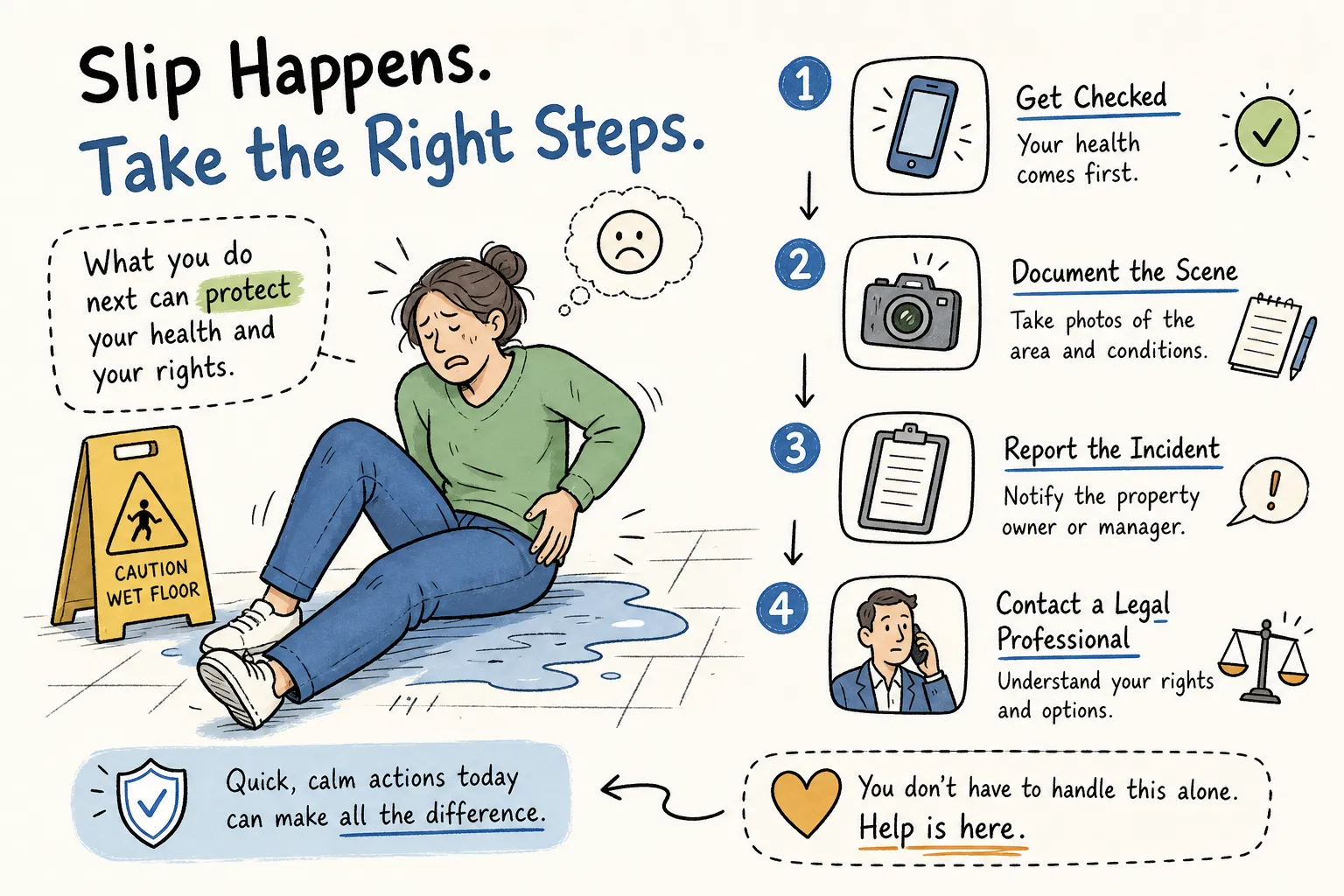
One second you’re walking through a Phoenix grocery store, parking lot, or apartment complex. The next, you’re on the ground, stunned, embarrassed, and in pain. The fluorescent lights feel too bright. Someone rushes over. And somewhere in the back of your mind, you’re asking: what do I do now? If you’ve been hurt, speaking with a slip and fall attorney Phoenix residents rely on should be near the top of that list, but first, there are steps you need to take immediately to protect your claim.
What happens in the next 24 hours can make or break a premises liability case. Property managers and their insurers often begin their own investigation quickly. Security footage gets reviewed. Incident reports document the business’s version of events and may later be used by the business or its insurer. If you don’t take specific steps fast, the evidence that would have supported your case quietly disappears.
This guide covers exactly what to do: immediate actions, evidence to gather, Arizona law deadlines, and how to find the right slip and fall attorney in Phoenix for your situation. Not because you were careless, but because nobody told you what to do until now.
What to do in the first 24 hours after a slip and fall
The hours right after a fall are the most critical window for protecting a future claim. Every minute that passes is a minute the property owner’s team is building their side of the story. You need to move just as fast.
Seek medical attention first, even if you feel fine
Delaying treatment is one of the most damaging mistakes an injured person can make. Insurance adjusters use the gap between a fall and a first doctor visit to argue the injury wasn’t serious or wasn’t caused by the incident. An urgent care visit or ER trip creates a dated medical record that ties your injury directly to the fall. Some injuries (soft tissue damage, concussions, internal bruising) don’t show full symptoms for hours or days, so what feels like minor soreness today can become something much more serious by morning.
Report the incident before you leave the property
Find a manager or property owner and request that an official incident report be filed. Ask for a copy before you leave; if they won’t give you one, write down the name of the person who took the report and the exact time. That incident report is one of the first documents a Phoenix premises liability attorney will request, and it often contains statements from staff, including details about how long the hazard had been there, that prove useful later in negotiations.
What not to say or sign at the scene
Resist the urge to apologize or say anything like “I should have watched where I was going.” Do not sign any form handed to you by a store manager or insurance representative on the spot. Recorded statements made at the scene can be used against your claim in later negotiations or litigation. Keep your responses brief and factual: your name, your contact information, and a basic description of what happened. Nothing more.
The evidence that decides a slip and fall claim in Phoenix
Once you’ve handled the immediate steps, the next priority is deliberate evidence gathering. The difference between a provable claim and a credibility dispute with no supporting evidence almost always comes down to what was captured and preserved in those first hours and days.
Photos and surveillance footage: capture the hazard immediately
Photograph everything: the hazard itself (wet floor, cracked pavement, broken step), the surrounding area, any signage, or the conspicuous absence of it, and your injuries. Surveillance footage is particularly powerful because it shows both the condition and the fall, but many systems overwrite footage within 24 to 72 hours. Once an attorney sends a legal preservation letter, the property owner is obligated to retain that footage; without that letter, it may be gone before you even make a call.
Witness statements and the incident report
Collect contact information from anyone who saw the fall or was nearby. A neutral third-party witness carries significantly more weight than a friend or family member who was with you. Return to the incident report as well: if it contains an admission from staff about how long the spill had been on the floor, that speaks directly to whether the property owner had constructive notice of the hazard, a core element of any Arizona slip and fall claim.
Medical records as proof of causation and damages
Medical records don’t establish liability on their own, but they prove the injury happened, when it happened, and what treatment it required. Consistent treatment records make it much harder for an insurance company to dispute the severity of your condition. Keep every receipt, prescription record, physical therapy note, and follow-up visit summary; those documents become the foundation of your damages calculation.
Arizona premises liability law: what the property owner owed you
Arizona law determines whether a property owner is legally responsible for your injuries. Understanding the basics helps you evaluate whether your case is solid before you even pick up the phone.
What you have to prove under Arizona law
A successful premises liability claim requires proving three things:
- The property owner owed you a duty of care (business customers are owed a higher duty than social guests);
- The owner knew or should have known about the dangerous condition and failed to fix it or warn you;
- That failure directly caused your injury and damages.
“Knew or should have known” has real teeth in practice. Whether a given duration establishes constructive notice is fact-specific and decided case by case, but as a practical example, if a spill sat on a supermarket floor for a significant period with no cleanup attempt and no signage, the owner may be deemed aware of the hazard regardless of whether anyone told them directly.
When to call a slip and fall attorney Phoenix injury victims trust
Under A.R.S. § 12-542, Arizona gives injury victims two years from the date of the fall to file a lawsuit. Miss that deadline and you almost certainly lose the right to recover anything. There’s a critical exception that catches people off guard: if the fall happened on City of Phoenix property or involved a government employee, a notice of claim must be filed within just 180 days, and the lawsuit deadline shrinks to one year under A.R.S. § 12-821.
That 180-day window is one of the most compelling reasons to consult a slip and fall attorney in Phoenix early, not six months from now.
How comparative negligence can reduce what you recover
The most common defense strategy in Arizona slip and fall cases is arguing that you share some responsibility for the fall. Here’s the reassuring part: being partly at fault doesn’t automatically kill your claim in Arizona.
Arizona’s pure comparative fault rule explained
Under A.R.S. § 12-2505, Arizona uses pure comparative negligence. That means you can recover damages even if you were 60% or 70% at fault; your award is simply reduced by your percentage of fault. In concrete terms: $100,000 in damages with a 20% fault finding on your end results in an $80,000 recovery. There’s no cutoff percentage that bars a claim entirely.
The defenses property owners most often raise
Expect these arguments: you were distracted by your phone, the hazard was “open and obvious,” you wore inappropriate footwear, or you ignored visible warning signs. A skilled Arizona slip and fall lawyer anticipates every one of these arguments and builds the evidence strategy around countering them. That’s exactly why photos of missing or inadequate signage matter so much, they directly undercut the “open and obvious” defense before it gains any traction.
What a Phoenix slip and fall claim is actually worth
No attorney can honestly guarantee a number at a first consultation. But you deserve a realistic framework for where your situation might fall, based on how Phoenix cases actually resolve.
Settlement ranges by injury severity
Phoenix premises liability cases tend to cluster around these ranges based on injury severity:
- Minor injuries (sprains, bruises, short treatment, no surgery): typically $8,000 to $50,000
- Broken bones and moderate fractures (including cases requiring surgery or extended physical therapy): typically $35,000 to $200,000, with serious fractures reaching up to $350,000
- Catastrophic injuries (TBI, spinal damage, permanent disability): $350,000 to $4,000,000 or more
Settlements above $75,000 generally require clear liability, documented permanent harm, or multiple surgical procedures. A brief ER visit with no follow-up treatment rarely supports a six-figure demand, regardless of how clearly negligent the property owner was.
The factors that move a settlement up or down
Total medical expenses, lost wages, future care costs, and pain and suffering all feed into the final number. The strength of your liability evidence matters, and any comparative fault assigned to you reduces the recovery proportionally. One practical ceiling that surprises many clients: the property owner’s insurance policy limits. A strong slip and fall claim in Phoenix AZ can still result in a lower recovery than the case deserves on its merits when the defendant is underinsured.
How to choose the right slip and fall attorney in Phoenix
You now know what to do immediately after a fall, what evidence to preserve, and what your case might be worth. The last piece is finding the right attorney to actually carry it forward.
The problem with high-volume “mill” firms
Large personal injury firms take on hundreds or thousands of cases at once. The founding partner who signed your fee agreement often never speaks to you again after intake; your case gets handed to a case manager, a paralegal, or a junior associate. In premises liability cases, where evidence preservation timelines are tight and comparative fault arguments require deliberate strategy, that hands-off approach is a client-experience concern that many injured Arizonans don’t anticipate until it’s too late.
What to ask during a free consultation
Before signing any fee agreement, ask these questions directly:
- Will I work with the attorney who signs my agreement, or will my case be handed to a case manager?
- How many active cases do you currently handle?
- What is your specific experience with premises liability claims in Arizona?
- What is your contingency fee percentage, and does it change if the case goes to trial?
- What is a realistic timeline for a case like mine?
The answers to these questions tell you more about a firm than any billboard or online review ever will.
Understanding contingency fees and what “no win, no fee” actually means
Phoenix personal injury attorneys handling slip and fall cases work on contingency, no upfront cost to you. The standard rate is roughly one-third (33%) of the recovery, with fees often rising to 38, 40% if the case proceeds to litigation. Ask specifically how case costs and out-of-pocket expenses are handled in the fee agreement, because that varies by firm and can affect your net recovery at the end.
Why boutique representation matters for your slip and fall case
At Law Angels, founding attorneys John Griffiths and Justin Johanson personally manage every premises liability case from the first phone call through final resolution. The firm’s stated policy is to limit its caseload so each client has direct attorney access, not a rotating roster of junior staff. You work with the attorneys who built the firm, not someone handed your file on day two. Law Angels operates on a pure contingency basis, so clients pay nothing unless the case wins. Call 844-THE-ANGELS to schedule a free, no-obligation consultation with the founding attorneys themselves.
Take the right steps now, your case depends on it
A slip and fall in Phoenix sets off a chain of decisions, and the ones made in the first 24 to 48 hours shape everything that follows. Get medical care immediately. Report the incident before you leave the property. Photograph the hazard and the scene. Preserve surveillance footage by contacting a slip and fall attorney near me Phoenix residents search for, one who can send a preservation letter the same day. Do not give recorded statements to insurance adjusters without legal guidance.
Keep Arizona’s deadlines front of mind: two years from the date of the fall for most private property claims, but only 180 days to file a notice of claim if a government entity is involved. That distinction alone is worth a free phone call to a Phoenix slip and fall attorney today.
If you or someone you love was hurt in a Phoenix slip and fall, the right next step is a conversation with a slip and fall attorney Phoenix injury victims can reach directly, not a case manager reading from a script. Law Angels offers free consultations with the founding attorneys themselves and handles every case on contingency. You focus on healing; the attorneys focus on your recovery.